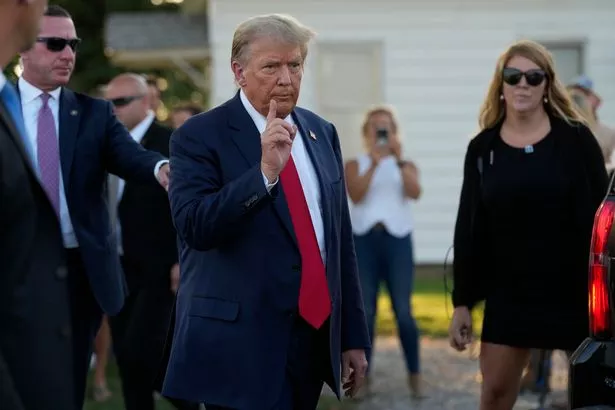
At a recent rally in Michigan, former President Donald Trump used the occasion to celebrate what he described as an exceptionally successful start to his second term in office. He declared, “According to many, many people, these have been the most successful first 100 days of any administration in the history of our country.” The speech was filled with bold claims on economic performance, immigration enforcement, and government efficiency, prompting scrutiny from fact-checkers, including BBC Verify.
One of Donald Trump’s central economic assertions was that gasoline prices had significantly decreased since he assumed office. “Gasoline prices are down by a lot,” he said, adding that “gas just hit $1.98 in a lot of states.” However, this claim does not align with official data. As of April 29, the national average price of a gallon of regular gasoline in the United States was $3.16, according to the American Automobile Association (AAA). This represents a slight increase from the $3.125 per gallon price recorded by AAA on the day Trump returned to the White House.
Furthermore, the claim that gas prices had dropped to $1.98 in several states appears to be unfounded. AAA data from the same date shows that no U.S. state had an average gasoline price below $2.67 per gallon. While gas prices have fluctuated, particularly in recent years due to global economic conditions and energy policy shifts, the evidence does not support Trump’s suggestion of a dramatic nationwide drop to under $2 per gallon .
Trump placed significant emphasis on the issue of illegal border crossings.
On the issue of immigration, Trump focused heavily on illegal border crossings, a signature concern during both of his presidential campaigns. “For two months in a row, we have set all-time records for the lowest number of illegal border crossings ever recorded,” he asserted. This claim is partially supported by government data. Official U.S. Customs and Border Protection figures show 7,181 migrant encounters at the U.S.-Mexico border in March and 8,346 in February. These are the lowest monthly figures since record-keeping began in 2000.
Comparatively, during the same months in the final year of President Biden’s administration, the number of migrant encounters was dramatically higher—approximately 140,000 each month. The Trump administration’s latest figures do mark a sharp decline, suggesting a significant shift in border enforcement and migration trends. However, it’s worth noting that experts, such as those from the Migration Policy Institute, caution against calling these figures “all-time” lows. Based on historical estimates prior to 2000, the current levels of illegal crossings may be the lowest since the late 1960s, but not necessarily the lowest in American history.

Trump also highlighted efforts to streamline government spending, attributing major fiscal savings to the work of the Department of Government Efficiency (DOGE), an advisory body tasked with identifying and reducing wasteful federal expenditures. He said, “They’ve saved over $150 billion on waste, fraud, and abuse.” According to the DOGE website, their estimated savings stood at $160 billion as of April 20.
However, this figure is somewhat opaque. BBC Verify found that less than 40% of the total savings listed are broken down into specific, itemized entries. These entries include examples such as cancelled federal contracts, discontinued grants, and the termination of underused government leases. Of those itemized examples, only about half are accompanied by documentation or any form of public evidence to verify the savings. This raises questions about the transparency and verifiability of the reported accomplishments.
In addition to praising DOGE, Trump acknowledged tech entrepreneur Elon Musk for his advisory contributions, further connecting the administration’s fiscal achievements to private-sector innovation. However, some analysts argue that without clear documentation or third-party auditing, it remains difficult to measure the actual impact of DOGE’s initiatives.
Trump’s rally speech in Michigan served as both a victory lap and a campaign-style message to his supporters, emphasizing achievements in energy, immigration, and economic stewardship. While some of his claims are grounded in verifiable data, others either lack supporting evidence or are contradicted by official statistics. As his administration continues to pursue its agenda, fact-checkers and analysts are likely to keep a close eye on the gap between rhetoric and reality.
-
Four Robbers Killed After High-Speed Chase and Shootout Near Norton Tollgate -
Heartbreak for Community After Missing Children Found Dead in Car -
Mutodi Sparks Storm with Guvamatanga Kickback Claims -
Magaya’s Top Aide Involved in Violent Brawl -
Mpilo Student Nurse Nabbed for Allegedly Using Fake ZIMSEC Certificate -
Chiwenga, Chivayo Rift Widens Over Broken Financial Promises -
ZACC Nabs NetOne CEO Mushanawani in US$1.2 Million Fraud Case -
Man Sparks Alarm After Leaving Loaded Gun at Lodge -
Madam Boss Avoids Cameras During Harare Court Appearance -
Zambezi River Crocodile Attack Leaves Veteran Guide Dead
