
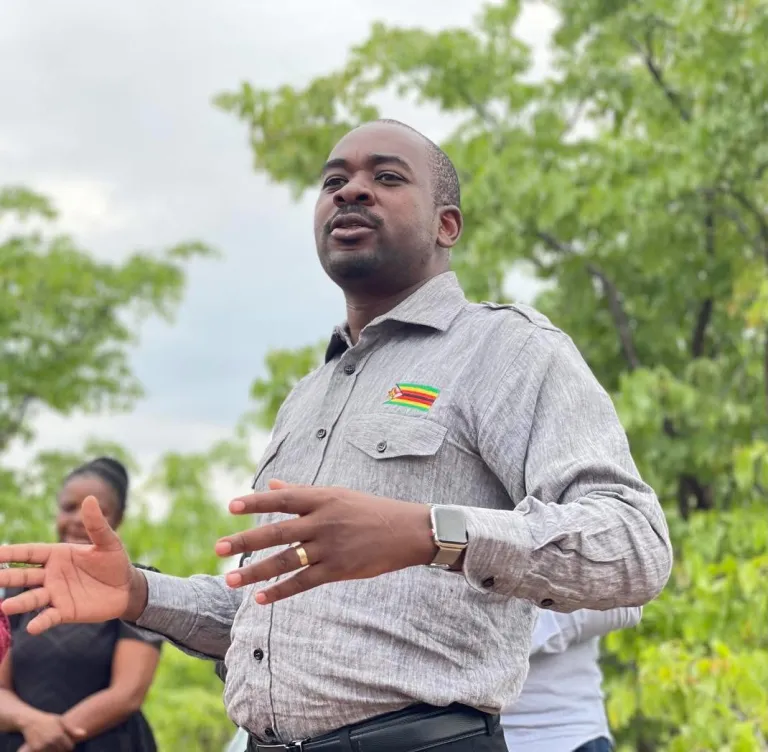
In a candid reflection on his political journey, opposition leader Nelson Chamisa has declared that stepping away from both the Movement for Democratic Change (MDC) and the Citizens Coalition for Change (CCC) was the most impactful decision he has ever made in his leadership career. The move, which surprised many of his supporters and critics alike, has now been framed by Chamisa as a deliberate and strategic action—one aimed at breaking what he described as a “cycle of going in circles.”
Speaking through a statement posted online, Chamisa did not mince his words: “The best decision I ever made in my leadership journey was to walk away from MDC and CCC. You will thank me later. I had to break the cycle of going in circles. And that was my best way to teach ED a lesson!”
The comment, which quickly went viral on social media and sparked national debate, signals a major turning point for Chamisa, who for years was seen as the face of Zimbabwe’s opposition politics. From his early days as a youthful MDC parliamentarian to his rise as the party’s presidential candidate, and later as the founder of CCC in 2022, Chamisa has consistently positioned himself as the main challenger to President Emmerson Mnangagwa’s leadership.
However, after years of political battles, factional infighting, contested elections, and increasing frustration with Zimbabwe’s rigid political landscape, Chamisa’s exit from the structures of formal opposition appears to have been a calculated reset—one that he now describes not as a retreat, but a strategic repositioning.
For Chamisa, the decision to leave both MDC and CCC was rooted in a deeper desire to escape what he called a “cycle of stagnation.” Over the years, the MDC fractured repeatedly, consumed by internal power struggles and legal challenges that weakened its effectiveness as a united force against ZANU PF. The formation of CCC was widely seen as a fresh start, but it too soon faced issues related to structure, leadership accountability, and internal sabotage.
Chamisa Reflects on Leadership Journey: “Walking Away from MDC and CCC Was My Best Decision”
“I realized we were stuck in a loop,” Chamisa reportedly told close aides. “Same faces, same methods, same outcomes. We needed to disrupt that rhythm to create space for real transformation.”
By stepping away, Chamisa suggests he is no longer playing by the rules set by the ruling party—a system he believes is designed to absorb, divide, and eventually neutralize opposition movements. To him, teaching President Mnangagwa “a lesson” doesn’t mean defeating him through traditional party politics, but rather disrupting the entire playbook.
Not everyone agrees with Chamisa’s framing of events. Some critics see his departure as a political misstep—leaving behind supporters without a clear roadmap or new vehicle for change. Others argue that stepping away from a functioning opposition structure at a time of deep national crisis is a sign of capitulation rather than courage.

Political analyst Eldred Masunungure said Chamisa’s move may be visionary, but it lacks the institutional support needed to sustain long-term impact. “Breaking cycles is important, yes, but leadership also requires clarity and consistency. Right now, there’s a vacuum,” he noted.
Still, Chamisa’s loyal base appears to be holding on, clinging to hope that the leader is laying the groundwork for something bigger—perhaps a new political platform that prioritizes citizens over party structures, or a civic movement that sidesteps conventional politics altogether.
In his message, Chamisa hinted that the public would eventually come to understand and appreciate his decision. “You will thank me later,” he wrote, suggesting that a new phase in his political strategy is underway, even if not yet fully visible to the public eye.
What comes next remains uncertain. With CCC now in disarray and MDC largely irrelevant on the national stage, Chamisa’s next steps will be closely watched by both his allies and adversaries. Some speculate that he may soon launch a new movement anchored on national unity, citizen empowerment, and ethical leadership. Others believe he might pivot toward grassroots activism or regional diplomacy.
What is clear, however, is that Chamisa sees himself as someone refusing to be part of a broken system. He has opted out of a game he believes is rigged—and in doing so, hopes to rewrite the rules of political engagement in Zimbabwe.
Whether that approach will succeed or falter remains to be seen. But in Chamisa’s view, walking away from MDC and CCC was not a sign of defeat. It was the first step toward liberation—from the system, from expectations, and from cycles that no longer serve the cause of real change.
Source- ZimEye
-

-

-

-

-

-

-

-

-

-

