
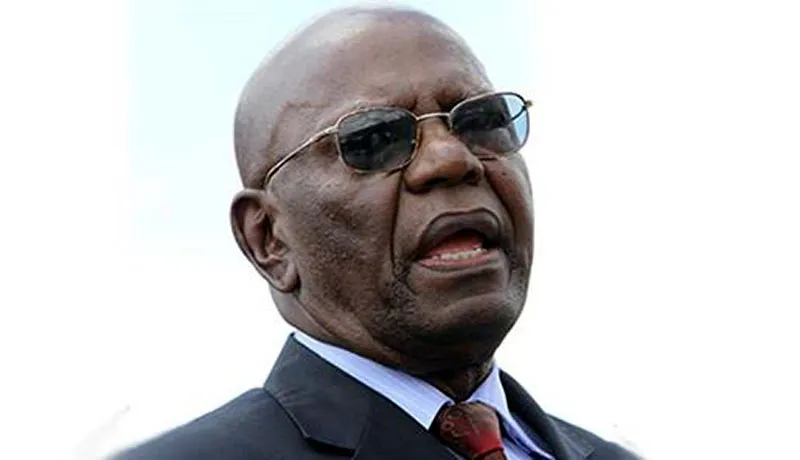
Veteran politician and former State Security Minister Didymus Mutasa has come out swinging against President Emmerson Mnangagwa, fiercely denying explosive claims that he attempted to hand over power to opposition leader Morgan Tsvangirai following Zimbabwe’s highly contested 2008 elections.
In a hard-hitting 17-minute video interview aired by online news outlet ZimEye, Mutasa described Mnangagwa’s allegations as “outright lies,” accusing the president of distorting history for political convenience. This marks the first time the long-serving ZANU PF elder has publicly addressed the issue in detail since Mnangagwa made the controversial remarks earlier this year during a campaign rally.
“There was no truth, no integrity. It was a lie—totally untrue,” Mutasa declared, visibly agitated as he responded to Mnangagwa’s assertion that he had cleared his government office and prepared to surrender power to the late Movement for Democratic Change (MDC) leader after ZANU PF’s disputed electoral loss in March 2008.
Mutasa, one of the last surviving founding members of ZANU PF, dismissed the claims as not only fabricated but deeply offensive, considering his decades-long loyalty to the ruling party. “I remained in my position, loyal to the party. I never cleared my desk, and I certainly did not work to hand over power to anyone outside ZANU PF,” he said.
He went further, describing the president’s comments as a deliberate attempt to rewrite history and vilify internal critics. “These are the same tactics used by Rhodesian propaganda,” Mutasa added, drawing a parallel to a notorious instance during the colonial era when white-controlled media altered a photo to depict him with a white beard in an effort to portray him as old and politically irrelevant.
According to Mutasa, Mnangagwa’s narrative is not only false but part of a broader campaign to discredit long-serving ZANU PF figures who have since fallen out of favour with the current leadership. He implied that Mnangagwa was exploiting revisionist storytelling to consolidate his own image while tarnishing those who once occupied influential positions within the party.
Mutasa Breaks Silence, Blasts Mnangagwa Over 2008 Claims and Liberation Credentials
The former intelligence chief also used the platform to question Mnangagwa’s credentials as a liberation war hero. In a pointed and loaded comment, Mutasa asked how a man accused of bombing a train—a reference to Mnangagwa’s oft-repeated claim of sabotage against the colonial regime—could have been so easily transferred between Rhodesian prisons without severe consequences.
“During those days, such an offence would have resulted in a swift execution. So how did he survive? How was he moved from one prison to another, seemingly unharmed?” Mutasa queried, casting aspersions on the authenticity of Mnangagwa’s war exploits.
He was not alone in his skepticism. Mutasa recalled how many younger ZANU PF members, including former youth league leader Kudzanai Chipanga, viewed Mnangagwa with deep suspicion, even during the liberation struggle. “There were always doubts about his true allegiance and role,” he said.
In a closing remark dripping with sarcasm and veiled criticism, Mutasa took issue with Mnangagwa’s tendency to override democratic processes and manipulate electoral outcomes. “There was nothing like that,” he said, in reference to the 2008 power handover claim. “No one gave him the authority to change the figures.”
The comment appeared to allude to long-standing allegations that Mnangagwa, then serving in a powerful behind-the-scenes role, was instrumental in delaying the announcement of election results and orchestrating a violent campaign that led to the controversial run-off in June 2008, which Tsvangirai eventually boycotted citing intimidation and killings of his supporters.
Mutasa’s statements are already sending ripples through Zimbabwe’s political circles, particularly as they come from a figure who once held some of the highest offices in the land, including Minister of State for Presidential Affairs and head of intelligence.
While the full 43-minute interview is set to be released in segments over the coming days, the preview alone has reignited debate over the contested legacy of Zimbabwe’s post-independence politics and the inner workings of ZANU PF’s ruling elite.
Observers say Mutasa’s intervention is significant, not only because of his history in the liberation movement and senior roles in government, but also because few senior figures have dared to so directly confront Mnangagwa since he assumed power following the 2017 military-assisted ouster of longtime ruler Robert Mugabe.
As Zimbabwe edges closer to another election cycle, Mutasa’s remarks are expected to raise uncomfortable questions for the ruling establishment—about the past, the present, and the stories that leaders tell to stay in power.
Source- ZimEye
-

-

-

-

-

-

-

-

-

-

