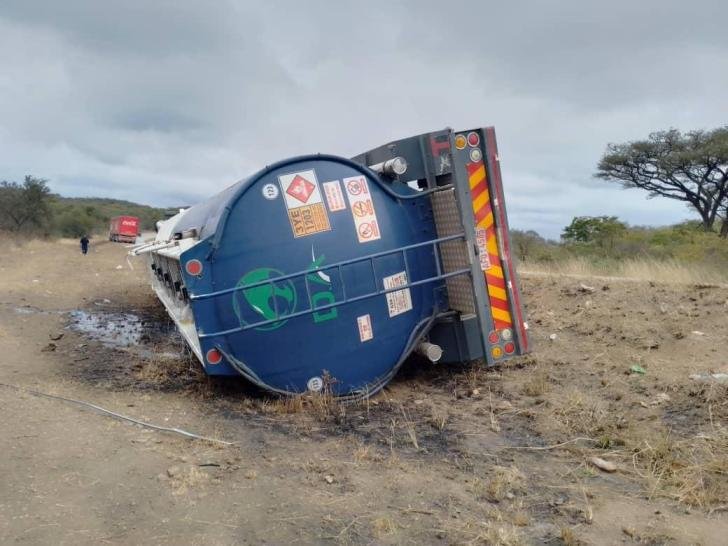
CHIRUMANZU, Midlands Province – A fuel tanker overturned in the early hours of Monday morning along the Gweru-Mvuma Road, resulting in the injury of the driver and triggering a rapid emergency response aimed at securing the scene and preventing a potential disaster.
According to preliminary information gathered at the site, the accident occurred in Chirumanzu District when the driver reportedly lost control of the vehicle while attempting to navigate a sharp curve. The large fuel tanker veered off the road and plunged into a roadside ditch, flipping onto its side. The force of the impact caused the tanker’s fuel cargo to begin leaking, prompting immediate safety concerns.
Eyewitnesses reported hearing a loud crash followed by the smell of fuel permeating the area. “It was just after 5 a.m. when we heard the sound,” said one local resident. “By the time we arrived, the fuel tanker was already on its side and fuel was flowing into the grass. We were scared it might explode.”
Fuel Tanker Overturns in Chirumanzu, Driver Injured as Authorities Scramble to Contain Spill
The driver, whose identity has not yet been released, sustained injuries during the crash and was quickly transported to a nearby medical facility for treatment. As of Monday afternoon, hospital officials had not yet provided an update on his condition.
In a country where fuel tanker accidents have historically led to tragic consequences, including deadly fires and community stampedes for leaking fuel, the authorities moved swiftly to avoid a repeat of past disasters.
Officers from the Zimbabwe Republic Police (ZRP) arrived on the scene within minutes of the incident being reported. They immediately cordoned off the area to keep residents and passersby from approaching the tanker. In previous years, similar accidents have drawn crowds hoping to collect spilled fuel—a practice that has proved fatal in other parts of Africa, including Zimbabwe’s neighbors.
ZRP Midlands spokesperson Inspector Emmanuel Mahoko confirmed the incident in a statement to the press and reiterated the dangers associated with tampering with accident sites involving hazardous materials.
“The public is strongly warned against approaching or attempting to collect fuel from such accident scenes. The risks involved are extremely high, including the possibility of ignition and explosion,” Mahoko said. “We are currently conducting a full investigation to determine the cause of the crash, but preliminary indications point to the difficulty of negotiating a sharp bend at high speed.”
The Gweru-Mvuma Road, a critical link in Zimbabwe’s national highway network, has seen several road traffic accidents in recent years, particularly involving heavy-duty vehicles. The route features numerous sharp curves and uneven surfaces that have long been flagged by motorists and transport operators as accident-prone sections in need of structural improvement and better signage.
As cleanup operations got underway, teams from the Environmental Management Agency (EMA) and the Civil Protection Unit were reportedly dispatched to assess environmental risks and coordinate fuel recovery to prevent contamination of surrounding soil and water sources.
“We are working in coordination with law enforcement and emergency services to contain the spill and reduce environmental damage,” said an EMA official on the scene. “Fuel spills can have serious long-term impacts if not properly managed, so swift intervention is key.”
Meanwhile, traffic along the Gweru-Mvuma highway was partially disrupted as authorities directed vehicles away from the crash site. Motorists were advised to use alternative routes where possible or to proceed with extreme caution when passing through the affected stretch.
The incident has once again raised alarm over the safety protocols—or lack thereof—in the transport of hazardous substances like fuel across Zimbabwe’s national roads. Critics argue that while the country depends heavily on road transport for fuel distribution, regulatory oversight and enforcement remain inconsistent.
Transport safety advocate and civil engineer Tendai Masunda told local media that Zimbabwe needs stricter standards and monitoring mechanisms for tankers and their operators.
“We cannot continue to rely on luck and after-the-fact emergency responses,” Masunda said. “We need a regulatory framework that mandates vehicle condition audits, driver training for hazardous materials, and infrastructure upgrades to reduce the risk of such accidents.”
As authorities continue to investigate the crash, the public is being reminded of the importance of road safety, particularly as Zimbabwe enters the second half of the year—a period historically associated with increased transport activity and accident rates.
The tanker accident in Chirumanzu serves as a stark reminder of the risks involved in the movement of dangerous goods, and the urgency of improving both road infrastructure and safety compliance in Zimbabwe’s growing transport sector.
-
One Killed in Tragic Bus Accident -
Police Arrest Eighth Suspect in Joseph Mutangadura Murder Case -
General Tongogara Honoured 46 Years After His Death -
Greatman Parts Ways With Manager Rastar After Three Years -
One Killed as Illegal Miners Fight Over Sex Worker -
Fresh Wave of Killings Reported in Guruve -
Chamisa Seeks Talks with Political Stakeholders -
Gospel Musician Everton Mlalazi Appointed to OK Zimbabwe Board -
Oscar Pambuka Receives a Toyota Fortuner from Wicknell Chivayo -
Presley Chweneyagae Property Frozen Over Charity Funds
