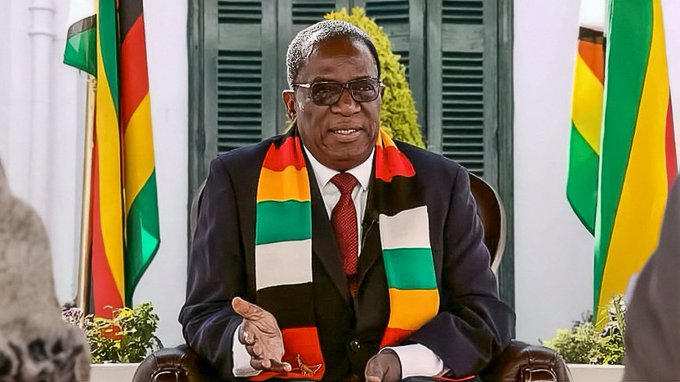
Mnangagwa Unleashes CIO On Chinese– President Emmerson Mnangagwa has ordered a stringent crackdown on Chinese-owned businesses in Zimbabwe, accusing them of engaging in illicit financial activities, environmental degradation, and flouting local laws. This move marks a sharp departure from the previously warm relations under Zimbabwe’s “Look East” policy, which, since the early 2000s, positioned Chinese investors as privileged partners in the country’s economic development.
Mnangagwa government’s tough stance became clear during a recent China-Zimbabwe Business Cooperation Roundtable held in Harare. Tafadzwa Muguti, Secretary for Presidential Affairs in the Office of the President and Cabinet, delivered a stern message to Chinese investors. He criticized the financial practices of many firms, asserting that “The majority of you business people are not banking money. You do not have bank accounts. You are keeping money under your mattresses, under the floor, or in the roof. But in China, you don’t do that.”
Muguti warned that such hoarding of foreign currency—including US dollars and the local Zimbabwe Gold coin (ZiG)—threatens the fragile national economy. “If everyone hoards US dollars and ZiG, the economy collapses. There will be no liquidity in the market. So, starting now, we are directing you to bank your money,” he said.
Concerns raised by Zimbabwean authorities include allegations that Chinese companies are operating largely outside the formal banking system, externalizing millions in undeclared earnings, and violating labour laws. In addition, there are serious complaints about environmentally harmful practices, particularly in mining sectors where Chinese firms are accused of reckless extraction.
Corruption and permit abuses have also come under scrutiny, with reports of some Chinese companies bypassing official channels and engaging in business operations without proper consultation with local communities. Muguti condemned the practice of Chinese nationals entering Zimbabwe as tourists to conduct illegal business activities, saying, “It’s not difficult for Chinese nationals to get investment permits. Why are you coming illegally? Let’s follow the protocols. No need to bribe anyone. Let’s do things properly.”
As part of the crackdown, new rules will require Chinese nationals applying for work permits or visas to submit letters of acknowledgment from the Chinese ambassador in Zimbabwe. This policy aims to ensure the government maintains full oversight of Chinese businesses operating in the country.
Mnangagwa Cracks Down on Chinese Businesses Amid Allegations of Illicit Activities
Muguti also expressed outrage over cultural insensitivity shown by some investors, especially in relation to mining activities disturbing ancestral burial grounds. “We are seeing companies digging up our ancestors’ graves and putting bones aside to start mining. That’s the greatest form of disrespect—even in your culture,” he said emphatically.
The government is pushing for better integration of Chinese nationals within local communities. Muguti urged the investors to “Take your children to our schools. Mix with Zimbabweans. Don’t go and create a Chinese camp. How are you going to understand Zimbabweans if you isolate yourselves?”
Moreover, Muguti reminded investors of Mnangagwa’s directive that all minerals extracted in Zimbabwe must be processed locally before export. “Zimbabwe wants to manufacture lithium batteries here. Let’s work together to build local industries. From here, you can export to the DRC, Malawi, South Africa, and beyond,” he stressed, highlighting the government’s ambition to develop a value-added mineral processing sector.
In response to these concerns, Steve Ke Zhao, CEO of the China-Zimbabwe Exchange Centre, acknowledged the government’s frustrations but pointed to bureaucratic hurdles as a major factor driving some Chinese investors into informal operations. “Some Chinese companies invest US$5 million or US$10 million, only to face challenges—such as delays in obtaining work permits or having machinery stuck at ports,” Zhao explained. “They’re forced into non-compliance not because they want to break the law, but because the system fails them.”
Mnangagwa Deploys CIO Against Chinese Business Interests
Zhao emphasized that the majority of Chinese investors are well-intentioned and genuinely committed to Zimbabwe’s development. However, many newcomers struggle with a lack of local knowledge, cultural differences, and complex regulatory procedures. To address this, he announced plans to organize workshops with banks and labour agents aimed at helping Chinese investors better understand and comply with Zimbabwe’s laws and customs.
The current crackdown and Muguti’s hardline remarks represent a significant recalibration of Zimbabwe’s approach to its largest foreign investor community. After years of uncritical acceptance, the government appears determined to assert greater control over Chinese business operations, enforce stricter compliance, and protect local interests—especially concerning economic transparency, environmental conservation, and cultural respect.
While the relationship between Mnangagwa’s Government and China remains strategically important, these developments underscore growing tensions and the need for a more balanced partnership that benefits both parties fairly and sustainably. How this crackdown will affect ongoing Chinese investments remains to be seen, but the message from Harare is clear: all businesses, regardless of origin, must play by Mnangagwa Government’s rules.