
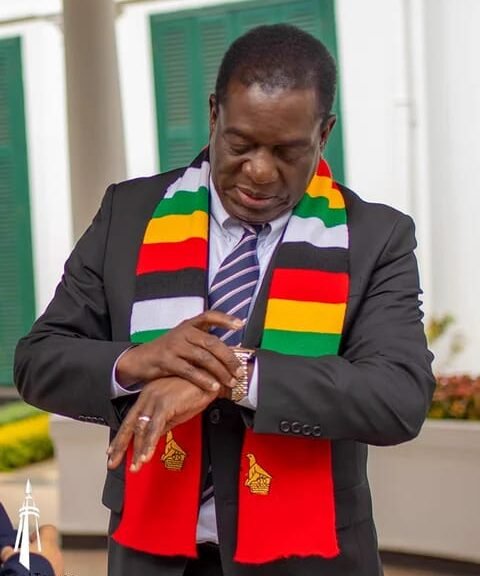
President Emmerson Mnangagwa has handed over a substantial US$200,000 to Apostolic and Zion church groups under what he described as the Presidential Empowerment Fund — a move that has sparked fresh controversy, with critics accusing the ZANU PF leader of engaging in blatant vote-buying ahead of future elections.
The announcement was made during the Vapostori4ED International Conference held in Harare on Saturday, where the funds were officially presented as support for church-based income-generating projects. The gathering, which drew thousands of congregants from various apostolic sects, was framed as a religious event dedicated to prayer for national development, but the political undertones were unmistakable.
According to Presidential Investment Advisor Paul Tungwarara, who presided over the ceremony, the money was personally sent by the President as a token of empowerment for the church.
“Mnangagwa has sent me to come and give you an empowerment fund of US$200,000,” Tungwarara told the crowd. “Everything has a starting point; it’s not about starting with a huge amount. This is a seed coming from the President. You therefore need to go and plant this seed and water it with prayers, and you will see it will blossom.”
While supporters of the initiative welcomed the donation as a demonstration of the President’s goodwill, critics argue that it is a calculated attempt to secure political loyalty from one of Zimbabwe’s most influential religious constituencies. Apostolic sects, particularly the white-robed Vapostori, have long been courted by the ruling party due to their massive followings and grassroots mobilisation capacity.
Vapostori4ED, the church-aligned affiliate of the ruling party’s broader For ED campaign, has gained momentum in recent years as the party aggressively pushes into religious spaces to solidify electoral support. Mnangagwa’s latest cash handout is seen by many as part of this broader strategy.
“This is nothing more than transactional politics dressed up as empowerment,” said political analyst Dr. Nyasha Mandizvidza. “The so-called ‘Presidential Empowerment Fund’ is being selectively disbursed to reward institutions that openly align with the ruling party. It’s a misuse of public-facing resources to engineer political loyalty.”
Indeed, the timing and optics of the handover have raised questions. The US$200,000 comes at a time when Zimbabwe is grappling with high inflation, widespread unemployment, and crumbling public services. Teachers, nurses, and other civil servants continue to push for better pay and working conditions, while hospitals and schools remain underfunded.
Meanwhile, large sums are being doled out at religious rallies, prompting concerns about the government’s fiscal priorities and accountability.
Mnangagwa Doles Out US$200,000 to Apostolic and Zion Churches Amid Vote-Buying Accusations
“This government claims there are no funds for basic services, yet there’s always money when it comes to political optics,” said an opposition spokesperson. “Church empowerment shouldn’t be conditional on pledging loyalty to the President.”
Despite the controversy, church leaders at the event were full of praise for Mnangagwa. Vapostori4ED Chairperson Madzibaba Moses Gwasira expressed gratitude on behalf of the apostolic community, describing the donation as a blessing and a reflection of the President’s inclusive leadership.
“We are grateful to receive this gift from the President of the Republic of Zimbabwe, Cde Emmerson Mnangagwa. He indeed has people at heart; he doesn’t discriminate. We are going to sit down and plan accordingly,” Gwasira said.
The event, hosted by the Johane Masowe eChishanu sect, also included spiritual sessions focused on praying for national peace, reducing road accidents, and seeking divine guidance for the country’s leadership as it pursues its Vision 2030 agenda.
In addition to the cash injection, Tungwarara also promised further development support for Vapostori4ED, including borehole drilling and toilet construction at apostolic worship sites — benefits that critics argue are being strategically directed toward politically aligned groups rather than distributed equitably across religious and community lines.
“The boreholes and toilets are part of a targeted patronage system,” said civil society activist Linda Ziwira. “What’s missing is a transparent framework that ensures all religious and community groups benefit from government programmes — not just those singing praises for Mnangagwa.”
While Mnangagwa’s team maintains that the Empowerment Fund is part of broader efforts to economically uplift marginalised communities, watchdog groups continue to call for stronger oversight mechanisms and a clear separation between state resources and party politics.
As the country inches closer to the next election cycle, the battle for religious support appears to be heating up — and with cash, infrastructure, and promises of prosperity being handed out at prayer gatherings, Zimbabwe’s churches are increasingly becoming both spiritual and political battlegrounds.
Source- ZimEye
-

-

-

-
-

-

-

-

-

-

