
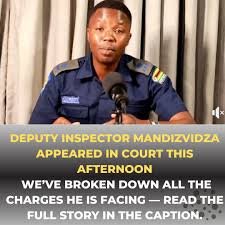
Assistant Inspector Simbarashe Mandizvidza, a 35-year-old officer stationed at the Police General Headquarters’ Salaries Services Bureau Liaison Office, has become the latest member of Zimbabwe’s security services to face accusations of plotting a coup. His case, currently before the Harare Magistrates’ Court, has reignited debate about the country’s history of alleged insurrections within the ranks of its military and police.
Mandizvidza appeared before Magistrate Vakayi Douglas Chikwekwe this week facing a combination of serious charges: causing disaffection within the Zimbabwe Republic Police (ZRP), fraudulently procuring a motor vehicle, and transmitting false data messages intended to cause harm. He was remanded in custody until 18 August to allow him time to secure legal representation.
According to prosecutors, Mandizvidza recorded and uploaded two separate videos to his YouTube channel, Gondo Harishaye, between 13 and 14 August. In the first, filmed at his Hatfield Police Camp residence, he allegedly declared himself the new commander of the ZRP.
In the footage, prosecutors say, he issued sweeping decrees, including an ultimatum ordering all Chinese nationals to leave Zimbabwe within 48 hours and an announcement that the ZRP’s Traffic Section had been disbanded. Authorities argue these statements were false, reckless, and calculated to cause both psychological and economic harm.
The following day, he allegedly posted another video in which he again proclaimed himself in charge of the ZRP while invoking the name of Commissioner-General Stephen Mutamba. The State contends this was a deliberate attempt to create confusion and disaffection within the police force.
Beyond the videos, Mandizvidza is also accused of fraudulently obtaining the use of a police vehicle. Prosecutors allege that on 13 August, he misled a senior officer into believing he had been authorised by a commissioner to use a Ford Ranger, registration ZRP 1033R. The vehicle was later recovered in Waerera village, Bindura.
The State insists these acts, taken together, amount to a serious breach of both the Police Act [Chapter 11:10] and the country’s criminal statutes. Prosecutors are opposing bail, warning that if released Mandizvidza might tamper with or delete crucial video evidence uploaded to his YouTube channel.
The ZRP has been quick to distance itself from Mandizvidza’s actions. Spokesperson Commissioner Paul Nyathi labelled him a “rogue policeman” and confirmed that disciplinary proceedings have been instituted under the Police Act in addition to the criminal case.
Assistant Inspector Mandizvidza Joins Long List of Security Officers Accused of Coup Plots
“The Zimbabwe Republic Police categorically disassociates itself from the reckless and unlawful pronouncements made by Assistant Inspector Mandizvidza,” Nyathi said. “The officer will face due process, both in terms of criminal prosecution and internal disciplinary action.”
Though unusual in its use of social media, Mandizvidza’s case is not the first time Zimbabwean security personnel have been accused of plotting coups. Over the past quarter century, nearly three dozen soldiers and officers have been implicated in similar allegations.
-
1999 Coup Allegations: At the height of Zimbabwe’s costly involvement in the Democratic Republic of Congo war, more than 20 army officers were arrested for allegedly plotting to topple then-President Robert Mugabe. Many spent extended periods in remand before their cases quietly collapsed.
-
2004 “Wonga Coup”: Dozens of foreign mercenaries, led by former British officer Simon Mann, were arrested in Harare en route to Equatorial Guinea, where they allegedly planned to overthrow President Teodoro Obiang. Mann was jailed in Zimbabwe before being extradited to Equatorial Guinea’s notorious Black Beach prison, though he later received a pardon.
-
2007 Matapo Case: Former army Captain Albert Matapo and six others were arrested and accused of planning to oust Mugabe and install Emmerson Mnangagwa. They endured nearly seven years in prison without conviction. Senior figures such as Ben Ncube, Engelbert Rugeje, and Elson Moyo were also linked to the alleged plot.
This long history reflects how Zimbabwean courts and security agencies treat any whisper of insurrection as a grave national security matter.
For Mandizvidza, the road ahead is uncertain. Legal experts suggest that, like previous coup-related cases, his trial could be lengthy and heavily politicised. “Such cases often drag on for years,” one analyst noted, “and in many instances the accused spend more time awaiting trial than serving any sentence.”
What distinguishes this case is the use of YouTube and social media to broadcast claims of authority — a development that prosecutors argue amplifies the potential for public disorder.
From 1999 to 2025, Zimbabwe has seen at least 28 security officers and soldiers accused of plotting coups, some facing long detentions while others quietly fade from the headlines. Whether Assistant Inspector Mandizvidza’s case results in conviction or becomes another drawn-out episode remains to be seen.
What is clear is that Zimbabwe’s security establishment continues to treat such matters with the utmost seriousness. As Mandizvidza sits in remand awaiting trial, his story joins a long, fraught history of alleged coup plotting in the country — a history where the line between genuine threats and political theatre has often been blurred.
Source- ZimEye
-

-

-

-

-

-

-

-

-

-

