
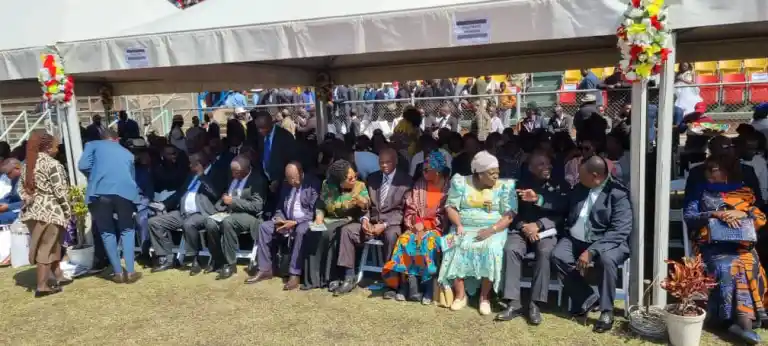
A rare display of apparent tension unfolded at Tuesday’s Defence Forces Day celebrations in Harare when ZANU PF spokesperson Christopher Mutsvangwa seemingly avoided greeting controversial businessman Kudakwashe Tagwirei, who was seated at the far end of the VIP tent. The incident, witnessed by numerous attendees, highlighted the growing factional undercurrents within Zimbabwe’s ruling party as it navigates internal politics ahead of the 2027 leadership race.
Mutsvangwa, accompanied by his wife Monica, arrived at the event with a measured and reserved demeanor. Unlike most senior government and party officials, he did not circulate among fellow dignitaries to exchange pleasantries or offer handshakes. His subdued approach stood in stark contrast to the customary cordiality that marked the arrivals of other high-profile figures, who moved around the VIP section with smiles, greetings, and brief conversations.
Among those observed engaging warmly with their colleagues were former Defence Minister Sydney Sekeramayi, ZANU PF stalwart Patrick Chinamasa, Harare Mayor Jacob Mafume, State Security Minister Lovemore Matuke, Senate President Mabel Chinomona, National Assembly Speaker Jacob Mudenda, and ZANU PF Harare provincial chairperson Goodwills Masimirembwa. These leaders adhered to the traditional protocol of acknowledging colleagues in the VIP section, ensuring visible unity and party solidarity.
Cold Shoulder at Defence Forces Day: Mutsvangwa Appears to Avoid Tagwirei
By contrast, Tagwirei — a close ally of President Emmerson Mnangagwa and a figure frequently at the centre of political and business controversies — remained seated quietly at the far end of the tent. While other officials greeted him, Mutsvangwa did not approach, prompting observers to speculate on the possible political motivations behind the snub.
Insiders suggest that the incident is reflective of deeper factional tensions within ZANU PF, which have been simmering in the lead-up to the party’s internal leadership contest. Mutsvangwa is reportedly opposed to Tagwirei’s recent elevation to the ZANU PF Central Committee, a move widely interpreted as part of President Mnangagwa’s broader strategy to position Tagwirei as his preferred successor when he steps down in 2028. The apparent avoidance has been interpreted by party watchers as a symbolic statement of dissent against this perceived succession plan.
The dynamics between Mutsvangwa and Tagwirei illustrate the complexities of Zimbabwe’s ruling party, where loyalty, influence, and succession ambitions frequently intersect. Analysts note that public displays such as the one witnessed during Defence Forces Day carry both political and symbolic weight, often serving as subtle indicators of shifting allegiances within the party hierarchy.
Observers also pointed out that Mutsvangwa’s decision to maintain a distance could be strategic, reflecting a desire to avoid public confrontation while signaling disapproval of Tagwirei’s rising influence. In political environments like ZANU PF, where optics and messaging are closely scrutinised, even minor gestures — or the absence thereof — can convey strong messages to party members and supporters alike.
Political commentators have linked the snub to broader debates about succession, patronage, and the role of business figures in Zimbabwean politics. Tagwirei, as a wealthy entrepreneur with close ties to the presidency, has often been seen as a polarising figure, attracting both support for his economic influence and criticism for his perceived encroachment into political spaces traditionally occupied by career politicians.
The Defence Forces Day event, intended to celebrate the contributions of the Zimbabwe Defence Forces and strengthen national cohesion, thus became an unexpected stage for demonstrating intra-party tensions. While most attendees maintained a formal and celebratory tone, the interaction — or lack thereof — between Mutsvangwa and Tagwirei did not go unnoticed by journalists, political analysts, and other VIP guests.
As Zimbabwe approaches the 2027 ZANU PF leadership race, factional manoeuvring is expected to intensify. Analysts argue that incidents like the one witnessed at the Defence Forces Day VIP tent are indicative of the subtle yet significant signalling that often precedes formal political campaigns. These moments provide insight into how senior party figures are positioning themselves and managing relationships ahead of potential shifts in the party’s leadership.
For now, both Mutsvangwa and Tagwirei have refrained from making public comments regarding the incident. However, party insiders and political observers are likely to continue scrutinising their interactions in upcoming events, as the optics of loyalty, influence, and succession remain central to Zimbabwe’s ruling party dynamics.
In the end, what was meant to be a day honouring the nation’s defence forces inadvertently highlighted the intricate web of politics, ambition, and symbolism that continues to shape ZANU PF’s internal landscape. The apparent cold shoulder between Mutsvangwa and Tagwirei serves as a reminder that even ceremonial events can reflect the underlying tensions and strategies that define Zimbabwean political life.
Source- ZimEye
-

-

-

-

-

-

-

-

-

-

