
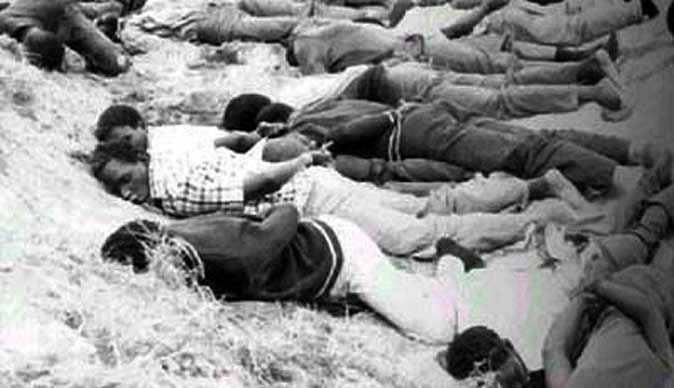
Gukurahundi -Police in Bulawayo have stopped a planned public meeting on the 1980s Gukurahundi massacres, barring a coalition of political parties and civic groups from gathering to discuss one of Zimbabwe’s most sensitive historical issues.
The meeting, which had been scheduled for Sunday at Stanley Square in Makokoba, was being organised under the banner of the recently launched Gukurahundi Genocide Alliance. The coalition includes opposition party ZAPU, Freedom Alliance, and several civic organisations from Matabeleland.
Organisers had urged participants to wear black as a symbol of mourning for the victims of the massacres, which claimed more than 20,000 lives in Matabeleland and Midlands provinces, according to the Catholic Commission for Justice and Peace (CCJP).
However, in a letter dated August 25 and addressed to alliance representative Samukele Hadebe, police said the gathering could not proceed. The correspondence, signed by Officer Commanding Bulawayo West District, Chief Superintendent K. Nyaumwe, cited non-compliance with the Maintenance of Peace and Order Act (MOPA) [Chapter 11:23].
“Please be kindly advised that your notification does not fully meet the guidelines specified in the Maintenance of Peace and Order Act. May you comply with the law,” the letter stated.
The police did not provide specific details of the alleged non-compliance.
Alliance representatives disputed the police position, insisting that they had met all legal requirements for holding the gathering.
“We do not know exactly what compliance is on our part because we notified them in writing and they stamped the notification paper,” said Cosmas Ncube of the Progressive Alliance Unions. “We are engaging the police on the matter.”
Organisers said they had filed their notification on August 14, well ahead of the required timeline, and believed the cancellation was politically motivated.
Police Block Bulawayo Meeting on Gukurahundi Massacres, Sparking Outcry
The decision to block the Bulawayo meeting comes amid increasing criticism of the government’s ongoing Gukurahundi outreach programme. President Emmerson Mnangagwa’s administration has tasked traditional leaders with conducting community hearings in affected regions, describing the process as a path to truth-telling, reconciliation, and healing.
But civic groups, opposition parties, and human rights organisations argue the state-led programme lacks independence and transparency. They say it is designed to manage the narrative rather than uncover the truth.
In a statement, the Gukurahundi Genocide Alliance condemned both the police action and the government hearings.
“We are not about to sanitise or be complicit in an unashamedly dishonest and grossly flawed process. We strongly condemn it, and it is obviously a predetermined outcome,” the alliance declared. “We unreservedly reject the current outreach programme as it has become clear to all that the government is neither sincere nor committed to truth-telling and a just resolution for genuine healing to happen.”
The Gukurahundi massacres remain one of Zimbabwe’s darkest and most divisive chapters. Between 1983 and 1987, the North Korea-trained Fifth Brigade, deployed under the orders of then Prime Minister Robert Mugabe, carried out a brutal counterinsurgency operation in Matabeleland and Midlands provinces. The campaign targeted perceived dissidents and supporters of the Zimbabwe African People’s Union (ZAPU).
The CCJP and other human rights groups estimate that more than 20,000 civilians were killed, with many more tortured, raped, or displaced. For decades, the massacres were a taboo subject, with open discussion discouraged by the state.
President Mnangagwa, who was State Security Minister at the time of the atrocities, has in recent years allowed limited space for dialogue. However, critics say his government has failed to acknowledge accountability or provide justice for victims and their families.
The blocking of the Bulawayo meeting has reignited calls for a more transparent and victim-centered process. Activists argue that true reconciliation requires independent truth-telling, accountability for perpetrators, and reparations for survivors and affected families.
“The government cannot prescribe how communities should remember or discuss their own trauma,” said one activist who attended the cancelled event. “Healing cannot be imposed from the top down. It must come from open dialogue, where survivors feel safe to speak.”
Analysts warn that restricting independent platforms risks undermining public trust in the government’s reconciliation efforts. They note that communities in Matabeleland continue to view state-driven initiatives with suspicion, given the lack of justice over nearly four decades.
By blocking alternative forums, critics argue, the state risks reinforcing perceptions that it is more interested in controlling the narrative than addressing the pain of survivors.
For now, the Gukurahundi Genocide Alliance has vowed to continue pressing for independent dialogue and justice, despite police efforts to curtail its activities. With emotions running high in Matabeleland, the fate of Zimbabwe’s long-delayed national healing process remains uncertain.
Source – Bulawayo24
-

-

-

-

-

-

-

-

-

-

