
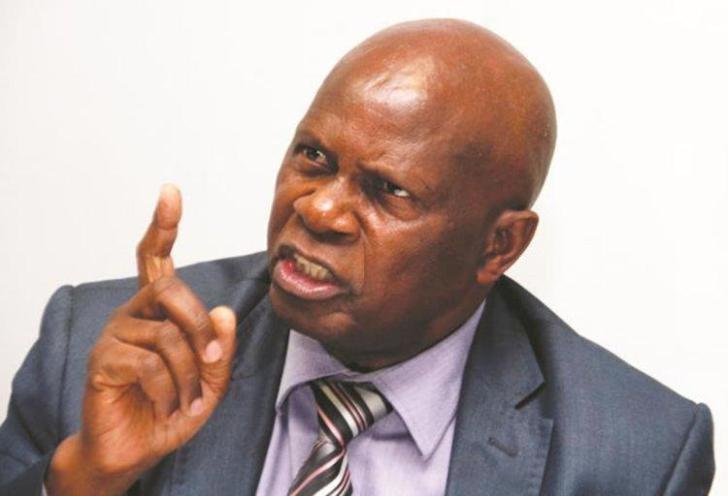
Zanu-PF Treasurer General Patrick Chinamasa has mounted a strong defense of President Emmerson Mnangagwa’s recent Politburo reshuffle, dismissing claims by Advocate Thabani Mpofu that the move was unconstitutional. Chinamasa argued that the criticism was both “baseless and misleading,” insisting that the Zanu-PF constitution clearly empowers the party President and First Secretary to make such changes.
The row was triggered after President Mnangagwa announced sweeping changes to the ruling party’s Politburo last month. Political analysts widely interpreted the reshuffle as a calculated attempt to limit the influence of Vice President Retired General Constantino Chiwenga, long viewed as Mnangagwa’s key rival in the ongoing succession battles.
Among the most notable changes, Obert Mpofu, once a dominant figure within Zanu-PF and regarded as sympathetic to Chiwenga, was removed from the powerful post of Secretary-General. He was reassigned to the less influential role of Secretary for Information Communication Technology (ICT).
In his place, Speaker of Parliament Jacob Mudenda was elevated to Secretary-General. Chinamasa himself was shifted from his previous position as Legal Affairs Secretary to become Treasurer General. These moves, observers note, significantly altered the balance of power within the ruling party’s highest decision-making organ outside congress.
Reports circulating within political circles suggest that Obert Mpofu may have had prior knowledge of a sensitive corruption dossier implicating influential businessmen Kudakwashe Tagwirei, Wicknell Chivayo, Paul Tungwarara, and Delish Nguwaya. The dossier was reportedly raised before the Politburo by Vice President Chiwenga, fueling speculation that Mnangagwa sought to weaken potential allies of his deputy.
Chinamasa Defends Mnangagwa’s Politburo Reshuffle, Rebukes Advocate Mpofu Over Constitutional Claims
The reshuffle prompted Advocate Thabani Mpofu, a prominent lawyer and opposition figure, to weigh in on social media. He argued that the changes violated Zanu-PF’s own constitution. According to him, Article 9 of the ruling party’s charter does not grant the President unilateral authority to reassign Politburo officeholders outside of an elective congress.
Advocate Mpofu contended that Mnangagwa’s moves undermined internal democracy within the party and set a dangerous precedent. His remarks quickly gained traction, sparking debate about the legal and political dimensions of the reshuffle.
Chinamasa, never one to shy away from political confrontation, wasted little time in firing back. Taking to his X (formerly Twitter) account, he dismissed Advocate Mpofu’s interpretation as a “classic case of mala fides” — an act of deliberate bad faith.
Quoting extensively from the party’s 2022 Constitution, Chinamasa cited Article 9, Sections 65 and 67, which he argued clearly vest appointment powers in the President and First Secretary.
“This language is categorical and unambiguous,” Chinamasa declared. “The authority vests in the President and First Secretary — not in any collective, committee, or ancillary structure. Thus, any personnel changes announced are lawfully anchored in the President’s prerogative. To argue otherwise is to deliberately distort the plain meaning of the text.”
Chinamasa further accused Advocate Mpofu of “wilful blindness,” saying his reading of the constitution was not only narrow but “fundamentally flawed.” He insisted that the Zanu-PF constitution must be read holistically, rather than selectively, and that Sections 65 and 67 explicitly empower the President to appoint, reassign, and remove Politburo members and department heads.
The sharp exchange between the veteran ruling party stalwart and the outspoken lawyer highlights the ongoing factional undercurrents within Zanu-PF. Mnangagwa, who secured re-election in 2023 amid opposition challenges, has spent the past year tightening his grip on the party as speculation over succession intensifies.
While Mnangagwa is constitutionally barred from seeking another term in 2028, questions linger over whether he might seek to amend the national charter or pave the way for a chosen successor. In this context, the Politburo reshuffle is widely viewed as part of his strategy to neutralize potential threats from within, particularly from the camp aligned with Vice President Chiwenga.
Chinamasa’s staunch defense of the President underscores the loyalty of Mnangagwa’s inner circle, but also signals that the legal and constitutional framing of such political moves is becoming increasingly contested terrain. Advocate Mpofu’s intervention, although from outside the ruling party, reflects the heightened scrutiny over Zanu-PF’s internal maneuvering.
As Zanu-PF approaches its next elective congress, the reshuffle and the legal arguments surrounding it are likely to remain a source of debate. For now, Chinamasa has sought to close ranks around the President, portraying the changes as entirely consistent with both the letter and spirit of the party constitution.
“The President’s decisions are anchored in law and procedure,” Chinamasa concluded. “To mislead the public into thinking otherwise is reckless and unhelpful.”
Yet, with succession rivalries simmering, corruption allegations swirling, and internal factions jostling for influence, the battle over who interprets the Zanu-PF constitution — and who benefits from that interpretation — is far from over.
Source- Bulawayo24
-

-

-

-

-

-

-

-

-

-

