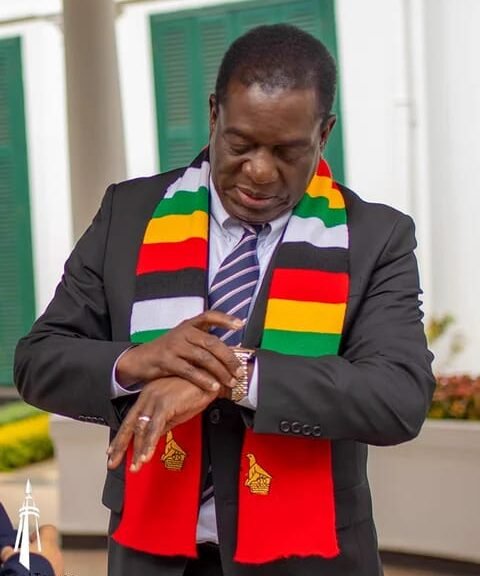
President Emmerson Mnangagwa’s State of the Nation Address (SONA) descended into chaos on Wednesday when a sudden power outage plunged Zimbabwe’s Parliament into complete darkness, forcing the Head of State to continue his speech by flashlight. The extraordinary spectacle, broadcast live to millions, has sparked national outrage and embarrassment, with critics describing it as a vivid metaphor for Zimbabwe’s worsening energy crisis and years of government mismanagement.
The blackout, which occurred midway through Mnangagwa’s address, interrupted proceedings for several minutes and left the President visibly struggling to continue. As aides scrambled to provide emergency lighting, Mnangagwa soldiered on under the dim glow of a handheld torch. Images of the moment — the President of a nation once known as the “jewel of Africa” reading his speech in darkness — have since gone viral, drawing ridicule both at home and abroad.
The timing of the incident could not have been worse. The government was using the SONA platform to reaffirm Resolution No. 1, a ZANU PF-led initiative seeking to extend Mnangagwa’s rule until 2030 or beyond. Instead of projecting stability and progress, the blackout offered a stark reminder of Zimbabwe’s crumbling infrastructure, widespread corruption, and unfulfilled promises of energy reform.
The debacle has reignited public anger over the Gwanda Solar Project, a long-stalled renewable energy initiative that has cost the country over US$23 million without producing a single watt of electricity. Launched in 2015, the project was meant to deliver a 100MW solar power plant to alleviate power shortages. Instead, it has become one of the country’s most notorious corruption scandals — and a national punchline.
Businessman Wicknell Chivayo, who received US$5 million upfront for the project a decade ago, has failed to install a single solar panel. Despite the lack of progress, the contract was inexplicably upgraded in recent years with an additional US$18 million, according to official reports. Meanwhile, Chivayo’s lavish lifestyle — private jets, luxury cars, designer wardrobes, and mansions — has become symbolic of state-sanctioned impunity in Zimbabwe’s political elite.
For many citizens, the blackout inside Parliament served as poetic justice and bitter irony: while the country’s leaders invest in vanity projects and patronage networks, the nation literally cannot keep the lights on during its most important political address.
Power Outage Turns Mnangagwa’s SONA into “State of the Darkness Address”
The incident dominated social media platforms within minutes, with Zimbabweans coining the phrase “State of the Darkness Address” to describe the fiasco. The President’s photographer, Cleopas Mukungunugwa, added fuel to the fire with a Facebook post attempting to deflect blame onto the opposition.
“The opposition can turn off the lights, but they can’t stop Resolution No. 1,” he wrote.
The remark was met with immediate backlash, with thousands of comments condemning the attempt to politicize what many saw as a clear failure of governance.
-
Tirimusango Wenje commented: “It’s because of the Gwanda Solar Project. Let’s tell Chivayo to deliver.”
-
Chikombedzi Chikombedzi added: “The Speaker of Parliament is the administrator. He can do better than this.”
-
Patrick Zangelo Ndlovu wrote: “Who doesn’t know there is load shedding in Zimbabwe? Let’s stop pretending.”
-
Farai Abraham fumed: “You’re sabotaging the President from within. Why do you think ZBC and the ZANU PF page aren’t reporting this?”
From opposition leaders to everyday citizens, the sentiment was nearly unanimous: the government has failed to provide even the most basic reliability in power supply, despite years of promises and billions in expenditure.
Observers say the blackout during Mnangagwa’s SONA will be remembered as one of the most humiliating moments of his presidency — a live demonstration of the dysfunction plaguing Zimbabwe’s energy sector.
“This was not just a technical glitch,” said one political analyst. “It’s a reflection of the rot within the system. The Gwanda project alone could have powered Parliament ten times over, but the money vanished into thin air.”
The event has amplified calls for accountability, with citizens demanding arrests and prosecutions over the solar scandal. Legal experts question why, despite public admissions by Chivayo that he received the funds without delivering, no meaningful legal action has been taken.
The Zimbabwe Anti-Corruption Commission (ZACC) has been accused of selective enforcement, targeting minor offenses while turning a blind eye to politically connected figures. The SONA blackout, analysts warn, may deepen public mistrust in state institutions and highlight the government’s inability to maintain basic infrastructure — even within its own corridors of power.
As of today, Parliament reportedly has no functional standby generator, raising further questions about preparedness for national events. The Office of the President has not issued an official statement, though insiders suggest that heads may roll within the Zimbabwe Electricity Transmission and Distribution Company (ZETDC) for failing to secure uninterrupted power during the address.
But for many Zimbabweans, the damage is already done. The image of their president — reading by flashlight in the heart of government — will linger as a haunting symbol of a country once rich in promise but now dimmed by corruption and neglect.
In a nation where millions endure daily load-shedding and decades of broken energy promises, the “State of the Darkness Address” may prove to be the most honest reflection yet of Zimbabwe’s current reality.
Source- ZimEye
-

-
-
-

-

-

-

-
-
-