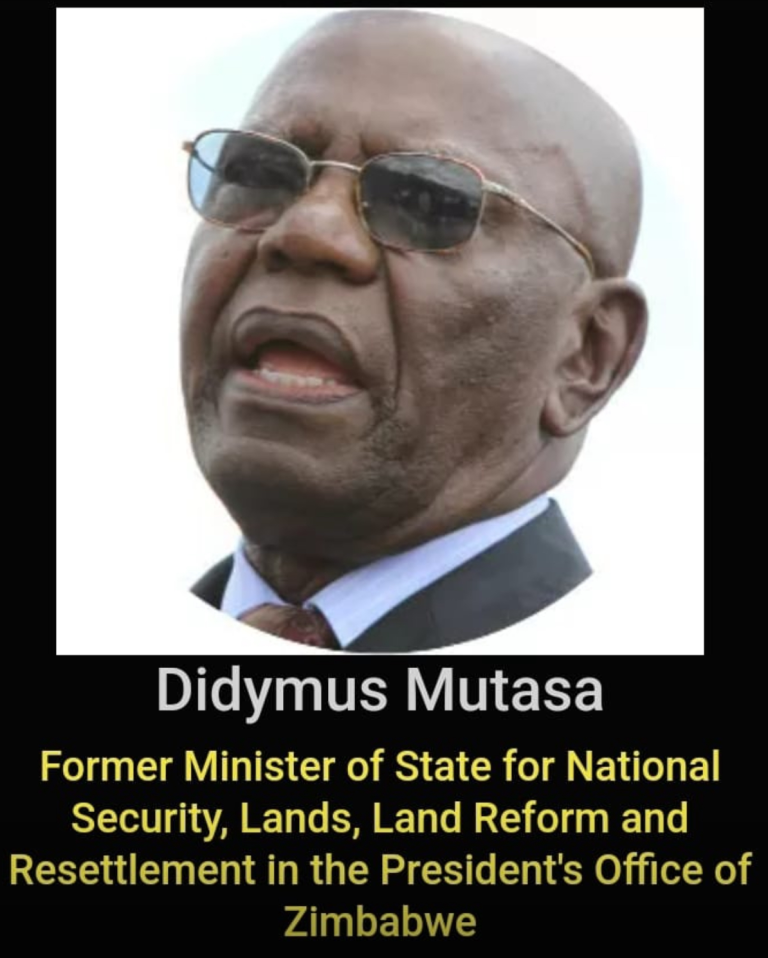
Cde Didymus Noel Edwin MutasaTurns 89

Veteran politician and former ZANU PF heavyweight, Cde Didymus Noel Edwin Mutasa, has turned 89, marking nearly a century of a life deeply intertwined with Zimbabwe’s political history. Born on July 27, 1935, Mutasa is one of the few remaining political figures whose career spans the liberation struggle, the dawn of independence, and the tumultuous decades that followed.

Known for his sharp tongue, political resilience, and controversial role in Zimbabwe’s post-independence governance, Mutasa has worn many hats over the years — from being a key member of the ZANU PF Politburo to serving as Speaker of Parliament and later, Minister of State for National Security, Lands, Land Reform, and Resettlement. His longevity in the political arena and proximity to power placed him at the heart of critical policy decisions, many of which have shaped the country’s socio-political and economic landscape.

Didymus Mutasa’s political journey began in the nationalist movement that fought for the end of colonial rule in Rhodesia. He was an early member of ZANU and played a significant role in rallying support for the liberation cause, both inside and outside the country. After independence in 1980, Didymus Mutasa quickly rose through the ranks of government, becoming one of the most trusted allies of then-President Robert Mugabe.

In the 1980s and 1990s, Didymus Mutasa served in various senior government roles, most notably as Speaker of Parliament from 1980 to 1990. His tenure in Parliament was marked by a strong push to consolidate ZANU PF’s dominance in the legislative sphere, often clashing with opposition figures and critics of the ruling party. Later, as a senior Cabinet minister, he was tasked with overseeing critical portfolios, including the controversial land reform programme.

As Minister of State for National Security, Mutasa also oversaw the Central Intelligence Organisation (CIO), Zimbabwe’s powerful domestic spy agency. In that role, he was regarded as one of the most feared and influential figures in the country, with considerable control over internal security and intelligence operations. His involvement in intelligence affairs during key electoral periods — particularly the 2000s — continues to draw scrutiny.

Ex-CIO Minister Who Briefly Declared Tsvangirai Election Winner (Didymus Mutasa) Turns 89

Perhaps one of the most significant moments in his political career came in the aftermath of the 2008 harmonised elections. Zimbabwe was plunged into crisis after opposition leader Morgan Tsvangirai defeated Mugabe in the first round of voting, only for the results to be withheld for over a month. During this volatile period, Mutasa is reported to have privately acknowledged that Tsvangirai had indeed won the poll — a rare moment of truth from within the ruling elite. Although no official concession was made, the comment became a key part of the historical narrative surrounding the disputed election and the eventual formation of the Government of National Unity.

Despite his loyalty to Mugabe and the ruling party, Didymus Mutasa’s political career took a dramatic turn in 2014. He became one of the highest-profile casualties of a purge that saw then-Vice President Joice Mujuru and her allies ousted from ZANU PF. Accused of plotting against the party leadership and aligning with internal dissenters, Mutasa was expelled and stripped of his powerful positions.

In the aftermath, Didymus Mutasa aligned briefly with opposition elements under the banner of Zimbabwe People First, a short-lived political outfit formed by ex-ZANU PF officials. However, the project failed to gain traction, and Mutasa soon faded from the national political stage.

Since then, he has lived a relatively quiet life, rarely making public appearances and occasionally speaking out on national matters through interviews and written statements. Though now removed from the corridors of power, his views on Zimbabwe’s governance, elections, and land reform remain of interest to both historians and political analysts.

As he turns 89, many reflect on Didymus Mutasa’s mixed legacy. Supporters hail him as a revolutionary who stood firm in defense of sovereignty and land rights, while critics view him as an enforcer of a repressive system that stifled dissent and weakened democratic institutions.

Political analyst Dr. Alex Madzudzo describes Mutasa as “a quintessential insider — deeply entrenched in the machinery of ZANU PF, yet one of the few who occasionally veered off-script.”

“He played a central role in the making of Zimbabwe’s post-independence political order, for better or worse,” Madzudzo said.

As the country continues to evolve under a new generation of leadership, figures like Mutasa serve as living archives of the turbulent journey Zimbabwe has taken since 1980. With most of his contemporaries now departed, his 89th birthday stands as both a personal milestone and a moment to reflect on an era that defined — and continues to shape — Zimbabwe’s political landscape

Source- ZimEye
Exit mobile version