
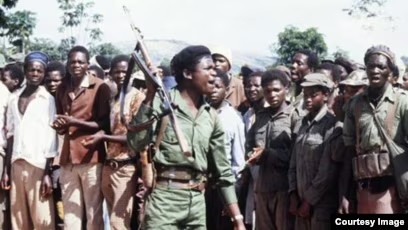
Zimbabwe’s war veterans have vowed to resist what they describe as a coordinated effort by morally questionable business figures to seize control of ZANU-PF, warning that the growing influence of money in internal party politics threatens to undermine the ruling party’s ideological foundation and betray the values of the liberation struggle.
The strong declaration comes as internal battles for influence within ZANU-PF intensify, with Vice-President Constantino Chiwenga finding himself at the centre of a fierce succession struggle. Chiwenga has increasingly voiced concern over the rise of individuals flaunting unexplained wealth while seeking political clout in the party. His criticism has been interpreted as a warning shot to those attempting to use their financial muscle to manipulate the party’s direction.
Speaking last month at the Zimbabwe National Chamber of Commerce (ZNCC) congress in Victoria Falls, Chiwenga decried a culture of conspicuous wealth accumulation without corresponding business activity, stating that such trends were corrosive to national values. In February, he famously introduced the term “zvigananda”—a Shona word for blood-sucking parasites—to describe these emerging political actors, widely believed to be a reference to controversial businessman Wicknell Chivayo, who is alleged to have strong links with President Emmerson Mnangagwa.
War Veterans Vow to Resist ‘Zvigananda’ Takeover of ZANU-PF Amid Growing Influence of Wealthy Elites
Adding to the chorus of concern, the Zimbabwe National Liberation War Veterans Association (ZNLWVA) has taken a firm stance against what it sees as a takeover of the party by these so-called zvigananda. Samuel Parirenyatwa, the association’s secretary-general, told The Standard that liberation fighters are alarmed by the creeping influence of moneyed elites in ZANU-PF.
“We went through hell during the liberation war to free this country,” said Parirenyatwa. “We fought for the people of Zimbabwe, not for a few individuals to enrich themselves by capturing the very party that carried the hopes of millions.”
He said the war veterans were acutely aware of efforts by the zvigananda to embed themselves within the party’s structures and steer it away from its founding values. “ZANU-PF’s ideology is rooted in people-centred development. These parasites have no loyalty to that vision. Their goal is personal enrichment at the expense of the masses,” Parirenyatwa added.


He expressed outrage that the party, which once served as a beacon of empowerment and liberation, is now being used as a tool to consolidate wealth and political influence for a small elite. “We are extremely disturbed by the visible opulence of these individuals, while ordinary Zimbabweans can’t afford basic services like healthcare and education. It’s a betrayal of everything we fought for.”
The outrage was echoed during ZANU-PF’s national assembly held on Friday, where President Mnangagwa surprised attendees by leading a chant of “Pasi ne zvigananda” (“Down with the zvigananda”), signaling a public denunciation of the growing clout of certain businesspeople in the party. His statement added fuel to the already raging debate over internal corruption, succession dynamics, and ideological drift within the ruling party.
Political observers suggest the president’s declaration may have been a strategic move to appease the restive war veterans and traditional party loyalists, many of whom have grown uncomfortable with the increasing influence of politically connected tenderpreneurs and newcomers who joined the party following the 2017 coup that removed long-time leader Robert Mugabe.
These newcomers are widely believed to support a faction pushing for Mnangagwa to extend his rule until 2030, despite mounting public discontent and concerns about economic mismanagement. Many within the party now see this push as being financed and driven by individuals with questionable loyalties and unclear sources of wealth.
The war veterans’ renewed activism marks a potentially significant shift in the balance of power within ZANU-PF. Once regarded as kingmakers and the moral backbone of the party, the veterans had largely receded from frontline politics in recent years. However, their vocal resistance to the zvigananda signals a possible resurgence of their influence, especially as the battle to define ZANU-PF’s future identity heats up.
Analysts say the clash between ideology and moneyed interests within the party is likely to intensify as the 2028 general elections approach. The core question is whether ZANU-PF will reaffirm its liberation roots or continue down a path where political authority is increasingly determined by wealth and patronage.
For now, the war veterans have made their position clear: they will not allow the sacrifices of the past to be undermined by what they see as opportunists hijacking the party of liberation. War Veterans resistance may yet prove to be a pivotal force in shaping the future of ZANU-PF—and Zimbabwe itself.


