
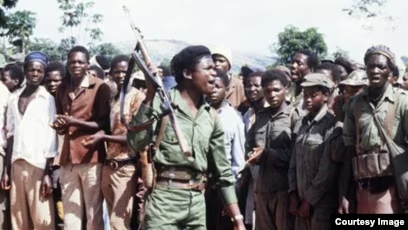
The Government has allocated 1 000 hectares of irrigation land to war veterans in Matabeleland North, a development officials say is part of broader national efforts to improve the welfare of former freedom fighters and recognise their role in the country’s liberation. The announcement was made during an interface meeting in Lupane last Friday, where senior Government officials engaged the veterans’ community on ongoing support programmes and outstanding commitments.
The meeting, held at the Lupane Town Board hall, brought together the Minister of Veterans of the Liberation Struggle Affairs, Monica Mavhunga, and war veterans from across the province. Also present were senior Zanu-PF officials and Members of Parliament. The session served as a platform for both policy updates and feedback from beneficiaries who continue to raise concerns about delays in the implementation of certain government initiatives.
Speaking at the gathering, Minister of State for Matabeleland North Provincial Affairs and Devolution, Richard Moyo, confirmed that the 1 000 hectares are located along the Gwayi-Shangani Lake corridor—an area earmarked for significant agricultural development once the dam and related infrastructure are complete. Moyo said the land allocation demonstrates the Government’s desire to empower war veterans through productive projects.
“This land is at the Gwayi-Shangani Lake corridor. The allocation is meant to empower the veterans in appreciation of their selfless sacrifice as they fought to bring majority rule,” Moyo said. He added that irrigation-based agriculture was chosen to ensure that the projects are sustainable and climate-resilient, particularly in a province that has faced recurring droughts.
Minister Mavhunga used the platform to update attendees on a number of national programmes targeting veterans. One of the key highlights was the long-awaited duty-free vehicle import scheme, which she said is now nearing completion. “The Attorney-General’s Office is finalising legal instruments to provide for duty-free vehicle imports, tax relief, and tollgate exemption for our war veterans,” she announced. The scheme, once operational, is expected to ease mobility challenges and support economic participation among former fighters, many of whom are engaged in farming or small businesses.
Beyond economic empowerment, Mavhunga emphasised the Government’s commitment to safeguarding the legacy of the liberation struggle. She outlined ongoing efforts to identify, exhume and rebury fallen heroes and heroines whose remains are still in unmarked graves both within Zimbabwe and in neighbouring countries. The initiative involves several ministries, as well as traditional leaders and international partners. President Mnangagwa has approved the creation of an inter-ministerial committee and a Liberation Heritage Fund to speed up exhumations, reburials and the preservation of heritage sites associated with the liberation war.


Mavhunga also highlighted the importance of ensuring that the spouses and dependants of declared heroes and heroines access statutory benefits. She noted that many eligible beneficiaries have, for years, been unaware of their entitlements. “Awareness campaigns are now being rolled out nationwide so that no family is left out,” she said, stressing that historical gaps in communication must be addressed.
However, despite the progress outlined by Government, local representatives of war veterans used the meeting to express their concerns about delays affecting key support programmes. Provincial chairperson of the War Veterans League, Sonny Mguni, reported that Matabeleland North has not yet received its share of the Presidential War Veterans Support Fund. The fund, which allocated US$200 000 to each province in June, was designed to support income-generating projects, welfare initiatives and emergency needs for veterans.
Mguni said the delays were now affecting livelihoods. “The province has resolved to seek clarity on the causes of the delays and the possible solutions in place to accelerate facilitation of the promises,” he told Minister Mavhunga. He added that war veterans had been hoping to launch income-generating projects by now, but the lack of funds had slowed progress.
The provincial leadership also raised concerns about other outstanding commitments. Mguni said that bicycles promised to war veterans in rural areas—intended to help with mobility—had yet to be delivered. He noted that transport remains a major challenge for many older veterans, especially those involved in community activities or local leadership roles. Similarly, he reported that construction of houses under the war veterans’ housing scheme had not yet begun, and no clear start dates had been communicated.
“In terms of infrastructure, only a demonstration borehole has been drilled so far,” Mguni added, noting that veterans had expected more tangible progress by this stage.
The meeting was attended by the Deputy Minister of Veterans of the Liberation Struggle Affairs, Headman Moyo, Nkayi North legislator and Politburo member Sithembiso Nyoni, as well as Zanu-PF Central Committee member Fati Mpofu. The high-level attendance underscored the importance Government places on ongoing dialogue with war veterans—both to honour their contributions and to ensure that the welfare measures designed for them are implemented effectively.
As the engagement closed, officials reiterated that the concerns raised would be referred to the relevant ministries for follow-up, with more updates expected in the coming weeks.
Source- BYO24


