
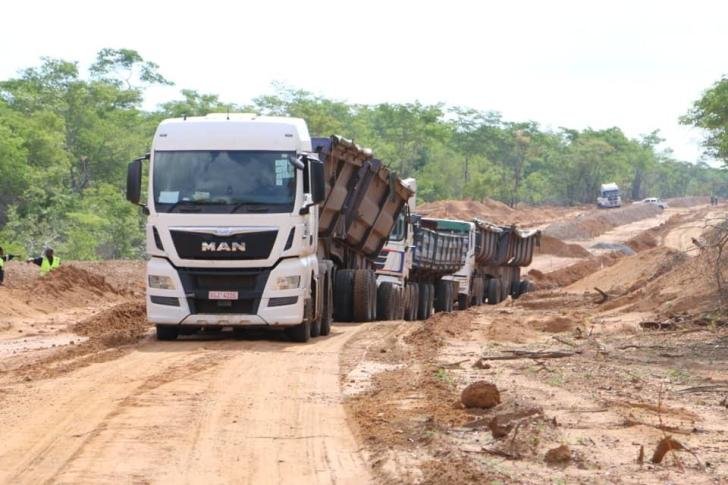
Motorists travelling between Bulawayo and Victoria Falls will have to exercise patience for several more months, as ongoing rains continue to delay progress on the massive highway resurfacing and expansion project. Contractors say persistent wet conditions are slowing work across multiple sites, leaving under 50km of the 440km route completed since construction began in August.
The project, which involves eight contractors on the Bulawayo–Victoria Falls road and a public-private partnership (PPP) operator on the new Lupane–Nkayi–Kwekwe corridor, is set to transform Zimbabwe’s western transport backbone. Once completed, the upgraded roads are expected to boost tourism, improve freight movement, reduce logistics costs, and support broader economic development in the region. For now, drivers must contend with diversions, heavy machinery, and uneven stretches.
On the Bulawayo–Victoria Falls route, contractors are working in 51km segments. Companies involved include Fossil Engineering, Masimba Construction, Bitumen Investments, Tensor Systems, Asphalt Products, Bitumen World, and Linash Construction. Fossil Engineering, responsible for the first 51km segment, says it remains on track to complete its allocation by September 2026. The company has already resurfaced its first portion and plans to add an additional 9km by mid-February. Beyond roadwork, Fossil is also drilling boreholes and constructing maintenance houses as part of its community development obligations.
Bulawayo–Victoria Falls Road Works Advance Slowly Amid Ongoing Delays
Masimba Construction, tasked with a 50km segment, is facing delays caused by heavy rainfall and trapped moisture in the base layers of the road. Project manager Blessing Nhau explained that moisture levels must drop below 50 percent before priming, a process that has taken more than seven days in certain areas. “The underlying Kalahari sand formation keeps moisture locked, which complicates drying efforts,” he said during a site tour. Despite these challenges, Masimba aims to prime 5km and complete surfacing before moving to the next 5km stretch. The contractor employs 74 workers, more than half drawn from nearby communities.
Further north, Bitumen Investments has primed 5.4km of its 51km allocation, with commissioning expected by mid-December. The full segment is scheduled for completion by December 2025. Tensor Systems anticipates surfacing 5km before the Christmas break, with full completion targeted for August next year. Asphalt Products is widening its stretch from seven to nine metres, aiming to have 16km ready by February and the remainder completed by August. The company is also contributing to local development by drilling boreholes and supplying pit sand to nearby schools for infrastructure projects.
In Hwange, Bitumen World is reconstructing and widening a 32km stretch to nine metres, designed to accommodate heavy mining and tourism traffic. Under contract manager Engineer Leeroy Msindo, the company is installing a weighbridge and maintenance camps to enforce axle-load compliance. Vehicle Inspection Department deputy director Eustina Nyathi warned that inspectors would act against overloading trucks, as coal hauliers have already caused damage to resurfaced sections.
Linash Construction, one of two women-led contractors on the project, is responsible for 52km of widening and asphalt overlay. Director Elina Shoko said the company aims to complete 10km before year-end, with full completion set for May 2026. Resident engineers Dumisani Shirichena and Adiola Kudzai Mudzingwa oversee work from opposite ends of the segment. “There is no job solely made for men or women,” Mudzingwa said. “What is required is mental strength, the right education, skill, determination, and vision.” Syvern Pvt Ltd, another women-led contractor, has opened 5km to traffic and targets completion of its 51km portion by August 2026.
Meanwhile, the 240km Lupane–Nkayi–Kwekwe road is progressing under a PPP model. Road Trackers, the contractor, has brought 15km to subgrade level, with the government aiming for 60km of progress over the next year. The corridor is expected to significantly shorten travel times between Harare and Victoria Falls. Across both projects, hundreds of workers have been employed in Lupane, Hwange, Lusulu, Cross Jotsholo, and Nkayi, with local communities benefiting from borehole drilling, school support, weighbridge construction, and maintenance camps designed to prolong road life.
Tourism operators are optimistic that the road upgrades will result in shorter, more reliable travel, while freight companies anticipate fewer breakdowns and tyre blowouts. However, until the project reaches completion, motorists will need to navigate construction zones, diversions, and heavy equipment—visible signs of what is shaping up to be Zimbabwe’s most ambitious road reconstruction effort since independence.
The Bulawayo–Victoria Falls highway, once fully upgraded, is expected to strengthen regional connectivity, enhance trade, and reinforce the country’s position as a tourism and logistics hub in southern Africa. For now, though, patience remains the order of the day.
Source- Byo24
-

-

-

-

-

-

-

-

-

-

