
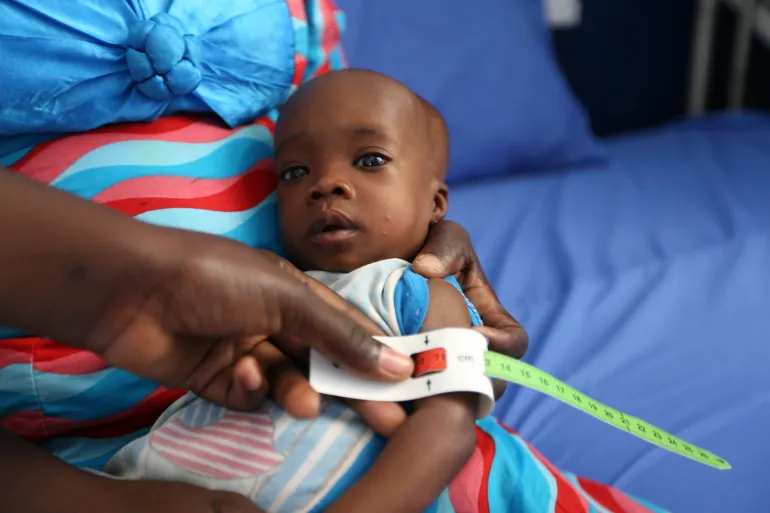
Malnutrition -At least 652 children have died from malnutrition in Nigeria’s Katsina State during the first six months of 2025, according to a stark warning issued by Doctors Without Borders (Médecins Sans Frontières, or MSF). The international medical humanitarian organisation blamed the alarming death toll on severe cuts in funding from major global donors, leaving thousands of vulnerable children without access to life-saving treatment.
In a statement released Friday, MSF revealed that it has treated nearly 70,000 children suffering from malnutrition in Katsina between January and June, including 10,000 cases that required hospitalisation in critical condition. Despite these efforts, the need for nutritional support remains immense across northern Nigeria, where insecurity, displacement, and crumbling public services continue to intensify the crisis.
“We are currently witnessing massive budget cuts, particularly from the United States, the United Kingdom, and the European Union, which are having a real impact on the treatment of malnourished children,” MSF said. “Unfortunately, 652 children have already died in our facilities since the beginning of 2025.”
Katsina State, located in Nigeria’s volatile northwest, is among the regions hardest hit by banditry and communal violence. Widespread insecurity has displaced tens of thousands of people, forcing them to flee their homes and abandon their farms—cutting off critical sources of food and income. This displacement, coupled with soaring food prices and weakened healthcare infrastructure, has created a deadly environment for the most vulnerable: children under five.
MSF said that the number of children presenting with the most severe form of malnutrition has skyrocketed—up by over 200% compared to the same period last year. Medical staff in the region are overwhelmed and under-resourced, struggling to meet the surge in cases with dwindling supplies.
Malnutrition Crisis in Nigeria: Over 650 Children Dead in Katsina as Aid Funding Dries Up
Compounding the crisis are frequent disease outbreaks—such as measles and cholera—that further compromise the health of already malnourished children. Low vaccine coverage, poor sanitation, and the limited availability of basic healthcare services have exacerbated the situation. “The need for prevention and treatment of malnutrition is enormous in northern Nigeria,” MSF warned, calling for urgent and coordinated mobilisation.
The looming humanitarian disaster is not limited to Katsina. On Wednesday, the United Nations World Food Programme (WFP) announced that it would be forced to suspend food and nutrition aid to over 1.3 million people in Nigeria’s conflict-ridden northeast due to what it called “critical funding shortfalls.”
WFP’s regional director, Margot van der Velden, said the agency has exhausted its food stocks and can no longer sustain operations in areas devastated by Boko Haram and Islamic State-linked insurgencies.
“This means more than 1.3 million people in Nigeria will lose access to food and nutritional support,” van der Velden said. “Around 150 nutrition clinics in Borno State may close. As a result, 300,000 children will be at risk of severe malnutrition, and up to 700,000 displaced people could be left with no means of survival.”
The WFP’s announcement has sent shockwaves through humanitarian networks operating in Nigeria, where over 8 million people are already in need of urgent assistance due to conflict, displacement, and extreme poverty. With the rainy season approaching—a time typically associated with poor harvests and increased disease outbreaks—the consequences of the funding gap could be catastrophic.
For years, the humanitarian response in Nigeria has relied heavily on support from the United States Agency for International Development (USAID), which has been instrumental in funding food security, healthcare, and shelter initiatives. However, sweeping aid cuts under the Trump administration—and continued reductions in foreign assistance budgets by other Western governments—have dramatically weakened this support system.
The US and other donors have increasingly diverted funds toward domestic concerns or other global crises, citing budget constraints, alleged mismanagement, and a shift in foreign policy priorities. As a result, critical humanitarian programs in Nigeria are being scaled back or halted altogether.
Nigeria’s government has attempted to step in by allocating 200 billion naira (roughly $130 million) to offset the shortfall in foreign health sector support. However, experts warn this is far from sufficient given the scale of the crisis and the need for robust, sustained intervention.
Health and humanitarian experts are now urging the Nigerian government, regional leaders, and international donors to urgently step up their efforts. Without renewed funding and strategic intervention, aid agencies warn that thousands more children could face death or lifelong health complications due to severe malnutrition.
“What is happening in Katsina and across the north is not just a humanitarian failure—it’s a moral one,” said an MSF field coordinator. “We have the tools to save lives, but we are being forced to turn away children because there simply aren’t enough resources. This cannot continue.”
With nearly 700 young lives already lost in just half a year, Nigeria’s malnutrition crisis demands immediate attention—not only from aid organisations but from the global community as a whole.
Source- aljazerra
-

-

-

-

-

-

-

-

-

-

