
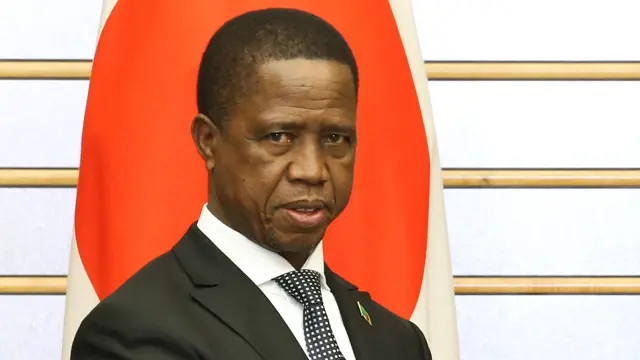
A South African court has ruled that the late Edgar Lungu, Zambia’s former president, must be repatriated to his home country for burial, ending a tense two-month dispute between his family and the Zambian government.
The ruling, delivered by the Pretoria High Court on Friday, directs that Lungu’s remains be “immediately” handed over to a representative of Zambia’s judicial system for transportation to Lusaka. There, the government has planned an official state funeral in line with national tradition for all former heads of state.
Lungu, who served as Zambia’s sixth president from 2015 until 2021, died on June 5 in South Africa while undergoing medical treatment. His death triggered a deep national reflection but also an emotional legal battle over his final resting place.
Family and State at Odds
The dispute centred on conflicting burial wishes. Lungu’s family had insisted on laying him to rest in Johannesburg, claiming this was in line with his personal preference to avoid a funeral attended by his political rival, current President Hakainde Hichilema.
Plans for a private burial were well advanced and a ceremony had been scheduled for June 25 in Johannesburg. However, just hours before proceedings were due to begin, the court issued an urgent order halting the burial, granting the Zambian government time to argue its case for repatriation.
The state’s position was that Lungu, as a former president, should be buried in Zambia with full honours at the designated presidential burial site in Lusaka — the resting place of all the nation’s leaders since independence from Britain in 1964.
A Divisive Political Figure
Lungu rose to power in 2015 following the death of President Michael Sata, securing victory in a tightly contested election. He was re-elected in 2016 but was defeated by Hichilema of the United Party for National Development (UPND) in the 2021 polls.
South African Court Orders Edgar Lungu’s Body Returned to Zambia for State Funeral
His post-presidency years were marred by legal troubles involving close family members. Since leaving office, his wife and children have faced a series of high-profile corruption and fraud charges, which they allege are politically motivated.
In February 2025, his daughter Tasila Lungu was arrested on money laundering charges, having already been detained alongside her mother and sister the previous year on separate fraud allegations. His son, Dalitso Lungu, is also facing corruption charges. The family maintains that these cases are part of a political vendetta orchestrated by the current administration.

Court’s Reasoning
In delivering the ruling, the Pretoria High Court stated that “a former president’s personal wishes or the wishes of his family cannot outweigh the right of the state to honour that individual with a state funeral.” The judge emphasised that state funerals serve as a national act of recognition for service to the country, transcending political rivalries.
The judgement effectively dismissed the family’s claim that Hichilema’s presence would dishonour the late leader’s memory. Instead, the court underscored the importance of national unity and historical continuity in burying presidents at the official site in Lusaka.
Reactions to the Ruling
Zambia’s Attorney General, Mulilo Kabesha, who attended the proceedings, welcomed the outcome. “The government appreciates the court’s decision, which upholds our commitment to giving our late president the honour he deserves,” Kabesha told reporters outside the courthouse.
For the family, however, the ruling was a devastating blow. Lungu’s sister, Bertha Lungu, broke down in tears in the courtroom as the judgement was read out. Speaking briefly to the media, she said the family was heartbroken that their wishes — and what they believe were Lungu’s own — had been overruled.
The case has sparked debate in Zambia about the balance between state protocol and the personal wishes of a deceased leader. Some citizens believe the government was right to insist on a state funeral, while others feel the family’s preferences should have been respected.

What Happens Next
With the court’s ruling now in place, arrangements are being made to transport Lungu’s remains from South Africa to Zambia. The Zambian government is expected to announce funeral dates and a programme for the state funeral, which will likely include a period of national mourning, a memorial service in Lusaka, and interment at the Presidential Burial Site.
As Zambia prepares to receive the body of its former leader, the court’s decision marks the conclusion of a legal standoff but not necessarily the end of the political tensions surrounding Lungu’s legacy. For supporters, he remains a symbol of leadership and patriotism; for critics, his presidency was tainted by corruption allegations and economic challenges.
What is certain is that the final chapter of Edgar Lungu’s life — and death — will now be written on Zambian soil, where history, tradition, and politics have converged to determine his final resting place.
Source- Ajazeera
-

-
-

-

-

-

-

-

-

-

