
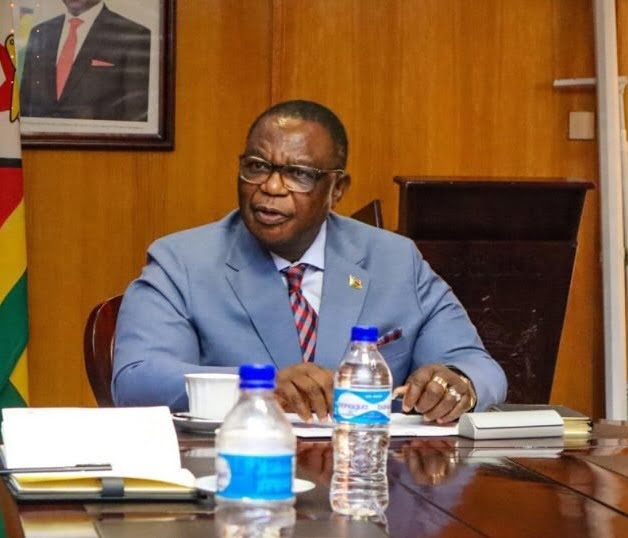
HARARE — Vice President Chiwenga last week stunned Zimbabwe’s ruling Zanu PF party by publicly silencing Central Intelligence Organisation (CIO) Minister Lovemore Matuke during a heated politburo meeting — a confrontation many see as a dramatic escalation of the party’s bitter succession wars.
The incident followed an earlier near‑physical showdown between Chiwenga and President Emmerson Mnangagwa at State House and later at Zanu PF headquarters on Wednesday, 17 September 2025. Well‑placed sources say the explosive exchanges have exposed deep fractures at the apex of Zanu PF, where corruption scandals, factional rivalries, and an unresolved succession question are colliding into a full‑blown political crisis.
According to insiders, the clash began when Matuke sought to defend Mnangagwa, dismissing Chiwenga’s corruption dossier as a politically motivated attack aimed at undermining the President. Chiwenga, however, responded with a sharp rebuke, lecturing Matuke on Zanu PF’s liberation war history and warning that factionalism had once threatened the party’s survival. He invoked the bloody 1974 Nhari Rebellion as a cautionary tale of internal division and collapse.
Earlier that day, Chiwenga had stormed State House unannounced to confront Mnangagwa directly. Standing before the presidium, he tabled a dossier alleging “industrial‑scale looting” by the President’s close business allies — a clique popularly dubbed the “Zviganandas.” These included politically connected tenderpreneurs such as Kudakwashe Tagwirei, Wicknell Chivayo, Pedzisayi “Scott” Sakupwanya, and Delish Nguwaya, whom Chiwenga accused of draining state resources and buying influence within Zanu PF.
“When Chivayo gives you ten million dollars, he will already have taken ninety million,” Chiwenga reportedly declared, warning that billions were being siphoned through fraudulent tenders and shadowy deals. He went further, suggesting that Mnangagwa was complicit in these schemes and that the businessmen were funding a campaign to extend the President’s rule beyond 2028.
Mnangagwa forcefully rejected the allegations, insisting he was a “constitutionalist” with no intention of overstaying his term. Yet his defence of the accused businessmen — including his remark that “Nguwaya is my friend” — only deepened the rift. In visible anger, Mnangagwa abruptly left State House and drove to party headquarters, leaving behind a visibly defiant Chiwenga.
Vice-President Chiwenga Silences CIO Minister in Dramatic Politburo Showdown — Zanu PF Succession Battle Deepens
At Zanu PF headquarters, the tension boiled over. Mnangagwa convened the politburo and, in a dramatic twist, presented Chiwenga’s dossier to members. He challenged them to decide whether he was failing as President. Silence filled the room. Turning to Chiwenga, Mnangagwa demanded an explanation. What followed was a blistering verbal assault. Chiwenga accused Tagwirei of “pocketing billions” from state contracts while depriving the party of resources.
“The party made him,” Chiwenga thundered, “and now he is feeding us crumbs.” He called for the immediate arrest of Tagwirei, Chivayo, and their associates, declaring corruption an existential threat to Zanu PF’s survival.
The confrontation rattled Mnangagwa. Within days, he reshuffled the politburo in what political analysts interpreted as a counter‑strike against Chiwenga’s allies. Obert Mpofu was demoted, Patrick Chinamasa shifted to Treasurer-General, and Jacob Mudenda was elevated to secretary‑general. Justice Minister Ziyambi Ziyambi assumed oversight of Legal Affairs, consolidating Mnangagwa’s hold on the party machinery.
Meanwhile, Zanu PF spokesperson Christopher Mutsvangwa went on the offensive, defending Tagwirei and mocking Chiwenga as “no superhero,” signalling that the party’s propaganda apparatus had been mobilised to discredit the Vice-President.
Despite the attacks, Chiwenga has remained defiant. In subsequent speeches, he branded Mnangagwa’s allies as “gluttons” and warned that the President’s reliance on corrupt businessmen threatened the state’s stability. His rhetoric has further polarised the politburo ahead of the party’s annual conference in October, leaving Zanu PF on edge.
For many observers inside the party, the spectacle of a President and his deputy coming close to blows is a chilling echo of 2017 — when top generals turned on former President Robert Mugabe, forcing his downfall. This time, however, the generals appear to be turning on each other, signalling a far more destabilising succession crisis.
The Chiwenga-Mnangagwa clash is now dominating political discourse, with factional loyalties hardening and alliances shifting daily. As the October politburo conference approaches, insiders warn that the party could face further internal ruptures, potentially reshaping Zimbabwe’s political landscape for years to come.
For Zanu PF, the succession battle is no longer a private matter. It has become a public contest for control of the party and, by extension, the state — a battle being waged in meeting rooms, State House corridors, and the national media. How it ends could determine not only who succeeds Mnangagwa, but also the future stability of Zimbabwe itself.
Source- ZimEye
-

-

-

-

-

-

-

-

-

-

